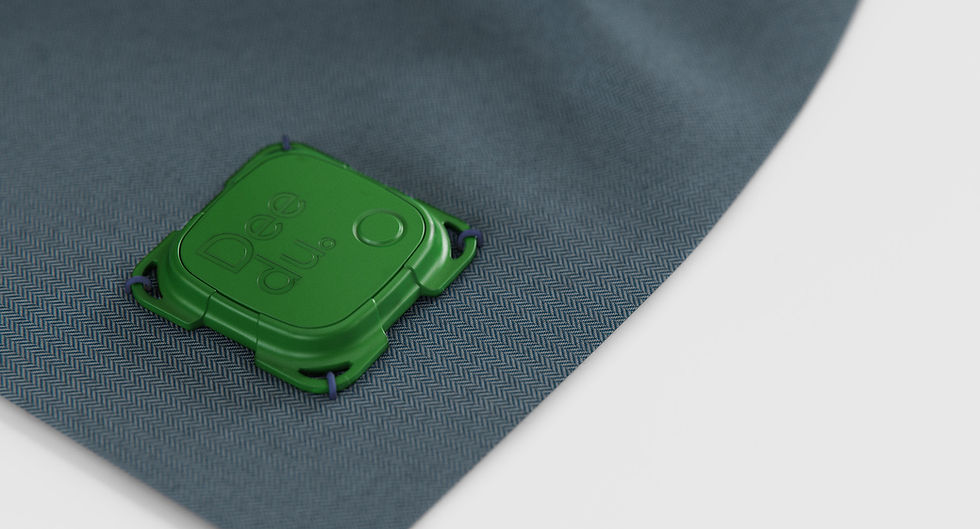
“Kids don’t play gently, and their favorite toys come in every material. This project challenged us to design a Bluetooth tracker that could attach anywhere and survive real play.”

Componet Layout Exploration
Before diving into design exploration, I studied the internal component stack-up to define a range of viable form factors. With the battery already near its minimum size, the focus shifted to optimizing the X–Y footprint and understanding the impact of adding features like a mounting hole. Establishing these constraints early was critical, as they directly informed and guided design decisions throughout the process.
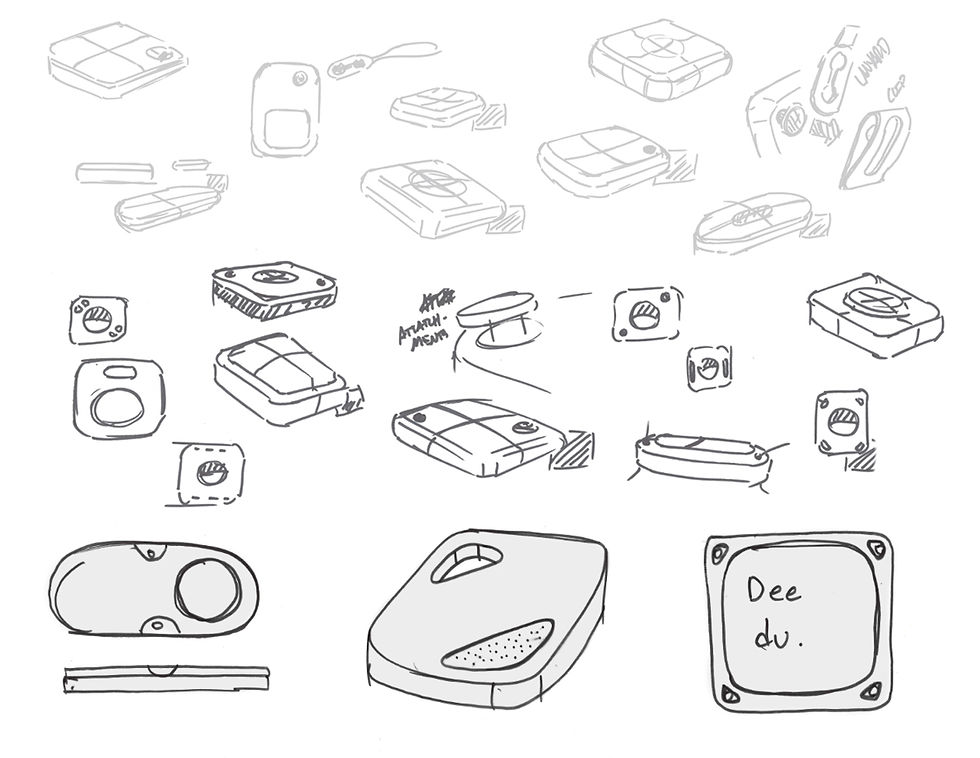
Exploring Form Factors based on Internals
At the outset, we prioritized designing a device that could adapt to a wide range of toys, using orientation as a key driver for both usability and attachment. Each direction offered distinct advantages. Some optimized for securing to narrow geometries, while others explored modularity to provide greater flexibility. In parallel, we focused on maintaining a compact form while developing a friendly, approachable design language that felt natural across different use cases. So finding balance between that technical requirement and the aesthetic was key.


Bringing it to Real Scale
Once we landed on a few form directions that felt right, we moved into CAD to validate them. The goal was simple: make this the smallest Bluetooth tracker possible. We arranged the internal components early so we could see, in a real and measurable way, how layout decisions affected overall size. Even small details like adding a hole had a noticeable impact, so every choice was intentional and grounded in the constraints. For the first phase, we used a torndown tile as a reference for board size and part placement.

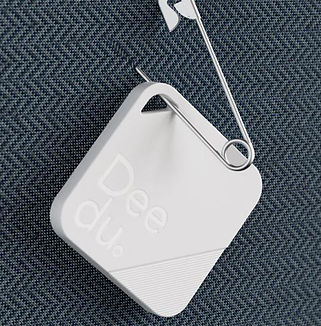

Phase 1 Concepts
By the end of the phase, we narrowed it down to three distinct form factors, each exploring a different way to attach across a wide range of toys. In parallel, we introduced an accessory-driven approach that gave the system more flexibility. If the user only needed a simple adhesive solution, the tracker could stay in its most compact form.
That balance is what pushed us forward. The accessory was small, adaptable, and opened up far more use cases without compromising size. So it became the direction we carried into the next phase.

Refining
After taking in the feedback, we refined the form to feel more friendly and seamless. A big focus was the snap-on accessory and making sure it had the flexibility to attach to just about anything. We built in multiple options: holes for pinning or sewing, tie-down points through the side dips, and an adhesive backing for quick use. It needed to work in any scenario without overcomplicating the experience.
*At the same time, we worked closely with the electrical engineering team. We gave detailed feedback on PCB layout and component placement to keep everything as compact as possible. A big challenge was dialing in the antenna orientation. Balancing performance with tight spatial constraints while working off real size references.